The Spider Web and the Engineer
A garden spider builds a web nightly without blueprints. The structure engineers worldwide study. What children learn from nature observation.
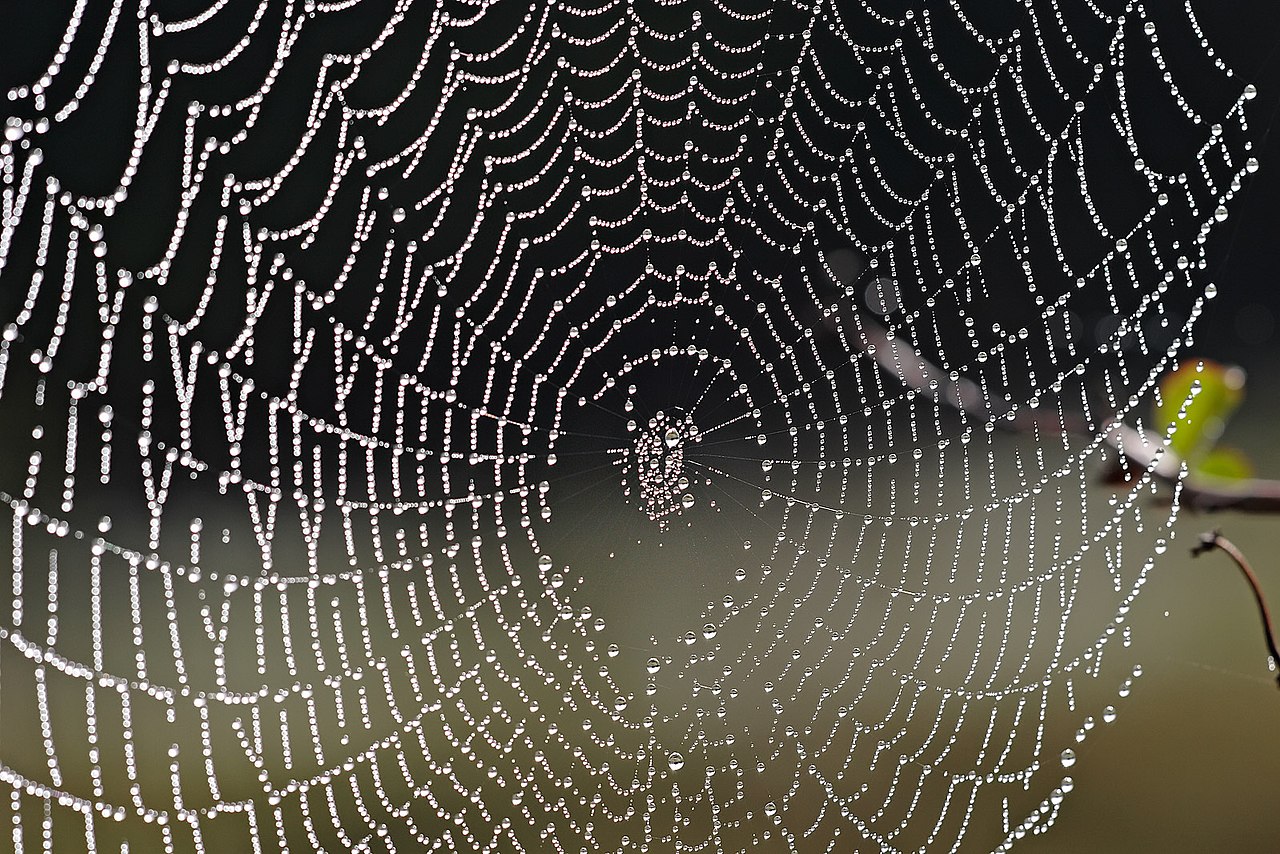
A spider web beaded with morning dew — each strand engineered by evolution over 380 million years. Image: Wikipedia Commons — CC BY-SA.
The Invisible Architect
There is a good chance that within ten metres of where you are sitting right now, a spider is at work. Not hiding. Working. Building a structure so precisely engineered that materials scientists spend careers trying to replicate its properties.
The orb web — the classic circular web with radial spokes and a spiral of sticky silk — is one of the most efficient structures in nature. It covers the maximum area with the minimum material. It absorbs the impact of a flying insect without breaking. And it is rebuilt from scratch, every single night.
A creature with a brain smaller than the head of a pin does this. Every night.
Spider silk is 5 times stronger than steel by weight, yet it can stretch to 40% of its length without breaking. Engineers are still trying to replicate it artificially.
What a Spider Web Actually Is
Spider silk is not one material — it is several. A single spider can produce up to seven different types of silk from different glands, each with different properties.
The radial threads — the spokes going from centre to edge — are made of dragline silk. This is the structural backbone. Weight for weight, dragline silk is stronger than steel and tougher than Kevlar. It does not stretch much, which is why the web holds its shape.
The spiral threads are different. They are coated with viscid silk — a sticky, stretchy material dotted with tiny glue droplets. These are the trap. When a fly hits the spiral threads, the glue holds it, and the stretch absorbs the impact so the web does not shatter.
The spider walks only on the dry radial threads and the non-sticky frame threads at the edges. It knows its own architecture perfectly. It never gets stuck.
The Mathematics
Orb webs follow mathematical patterns that appear repeatedly in nature. The radial threads spread out from the centre at roughly equal angles — the same principle that governs how seeds pack in a sunflower head or how cells divide in an embryo. The spiral follows a logarithmic pattern, tightening toward the centre where the spider sits, maximising capture area in the outer zones where insects are more likely to fly.
This is not designed. It is evolved. Millions of years of trial and error have produced an organism that executes geometry more precisely than most human-built structures, using nothing but its own body.
What Engineers Are Learning
Spider silk has inspired research in materials science, architecture, and even medicine. Scientists at MIT and Oxford have studied how the web distributes stress — when one thread breaks, the load transfers to neighbouring threads without cascading failure. This is the opposite of how most human-made structures fail.
Surgeons are exploring synthetic spider silk for sutures and tissue scaffolding because of its biocompatibility and strength. Architects have studied web geometry for lightweight tensile structures.
A creature that most people brush away without a thought has been solving engineering problems for 380 million years — since before the dinosaurs.
The Lesson for Children
The next time you see a spider web in the morning — perhaps strung between a gate and a wall, or between two branches of a neem tree — stop. Do not destroy it. Look at it.
Count the radial spokes. Notice how the spiral tightens. Look for the tiny glue droplets on the sticky threads. If there is dew on the web, you will see the entire structure lit up like a chandelier.
You are looking at one of the finest engineers on Earth. And it weighs less than a grain of rice.
Wonder is not something you have to travel far to find. It is waiting in the nearest garden, if you are willing to look.
Spark wonder
Tap to register your wonder
Share
Continue Reading
More articles connected to what you just read
What question did this raise for you? Add it below.
Reflections
Add your reflection
All reflections are reviewed before appearing. Keep it thoughtful.