The Soil Beneath Your Feet Is Alive
A teaspoon of healthy soil holds more life than people on Earth. The most complex ecosystem children in Varanasi can touch every day.
Rich, living soil — a teaspoon holds more organisms than all humans who have ever lived. Image: Wikipedia Commons — CC BY-SA.
What You Are Standing On
There is a world beneath your feet that is more densely populated than any city, more chemically complex than any laboratory, and older than any civilisation. It does not move. It does not make noise. And because it does not demand attention, almost nobody gives it any.
Soil.
A single teaspoon of healthy garden soil contains approximately 1 billion bacteria, several yards of fungal threads, tens of thousands of protozoa, and thousands of nematodes. It contains more individual living organisms than the total number of humans who have ever existed.
This is not metaphor. This is count.
One teaspoon of healthy soil contains 1 billion bacteria, 100,000 fungi filaments, 10,000 protozoa, and 100 nematodes. It is the most densely populated habitat on Earth.
The Underground Internet
In the 1990s, a forest ecologist named Suzanne Simard discovered something that changed how we understand forests. Trees, she found, are not competing individuals. They are networked.
Beneath the forest floor, mycorrhizal fungi — threadlike organisms thinner than a human hair — connect the root systems of different trees into a shared communication and resource network. Through these fungal threads, trees exchange carbon, nitrogen, phosphorus, water, and even chemical warning signals.
A mother tree, Simard found, will preferentially send nutrients through the fungal network to its own seedlings. When a tree is dying, it dumps its remaining carbon into the network for its neighbours. Trees of different species share resources through the same fungal intermediary.
Scientists now call this the Wood Wide Web. It is not a metaphor coined for popular science — it is a description of a real, functioning communication network that has existed for approximately 450 million years. The human internet is 50 years old.
What Soil Actually Is
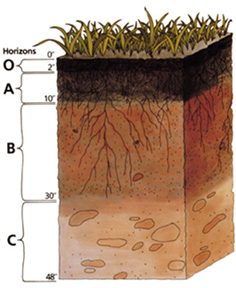
Soil is not dirt. Dirt is what you sweep off the floor. Soil is a living system, and it is built in layers that took centuries to form.
The top layer — the dark, crumbly part — is humus. It is the decomposed remains of leaves, roots, insects, and microorganisms, transformed by bacteria and fungi into a stable organic material that holds moisture and nutrients. It takes nature approximately 500 years to produce one inch of topsoil.
Beneath humus is the mineral layer — particles of rock broken down by water, wind, temperature, and the slow chemical action of lichens and plant roots over geological time. The ratio of sand, silt, and clay in this layer determines whether the soil drains quickly or holds water, whether it is easy to dig or hard as concrete.
The Indo-Gangetic plain — the flat alluvial stretch where Varanasi sits — has some of the most fertile soil on Earth. It was built over millions of years by rivers carrying Himalayan sediment southward and depositing it across the plains. Every grain of soil in a Varanasi field was once part of a mountain.
The Problem We Are Creating
Humanity is losing topsoil at a rate of approximately 24 billion tonnes per year. Intensive farming, deforestation, and construction strip the living layer faster than nature can rebuild it.
The United Nations has estimated that at current rates of degradation, the world has roughly 60 years of topsoil left. After that, growing food in conventional ways becomes difficult to impossible.
This is not a distant crisis. It is a slow-moving one that is already visible. Yields in parts of the Indo-Gangetic plain are declining despite increased fertiliser use — because chemical fertiliser feeds the plant but does not feed the soil. The microorganisms that maintain soil structure and fertility are dying. The fungal networks are fragmenting.
A field that has been chemically farmed for decades has soil that looks grey and lifeless. A field that has been composted and cover-cropped has soil that is dark, crumbly, and full of earthworms. The difference is not subtle. A child can see it.
Why This Belongs in Every Classroom
Most children can name the planets. Very few can name the organisms in the soil under their school building. This is an extraordinary failure of priority.
The planets are magnificent, and we should teach them. But the soil grows the food. The soil filters the water. The soil stores more carbon than the atmosphere and all plant life combined. It is, by almost any practical measure, the most important natural system on Earth.
A child who picks up a handful of soil and understands what they are holding — the bacteria, the fungi, the nematodes, the centuries of accumulated decomposition — is holding something more complex than any device they will ever own.
And that is worth knowing.
The soils of Varanasi and the surrounding villages of the Indo-Gangetic plain are classified primarily as alluvial — young, nutrient-rich, and among the most agriculturally productive on the subcontinent. The farmers who work this soil have understood its rhythms for millennia.
Spark wonder
Tap to register your wonder
Share
Continue Reading
More articles connected to what you just read
Learning
The Sky Has Changed: What Climate Change Is Doing to Weather — and to Varanasi
What question did this raise for you? Add it below.
Reflections
Add your reflection
All reflections are reviewed before appearing. Keep it thoughtful.