The Sky Has Changed: What Climate Change Is Doing to Weather — and to Varanasi
The Varanasi monsoon is behaving differently now — angrier, more erratic. Understanding climate change is essential for children alive today.
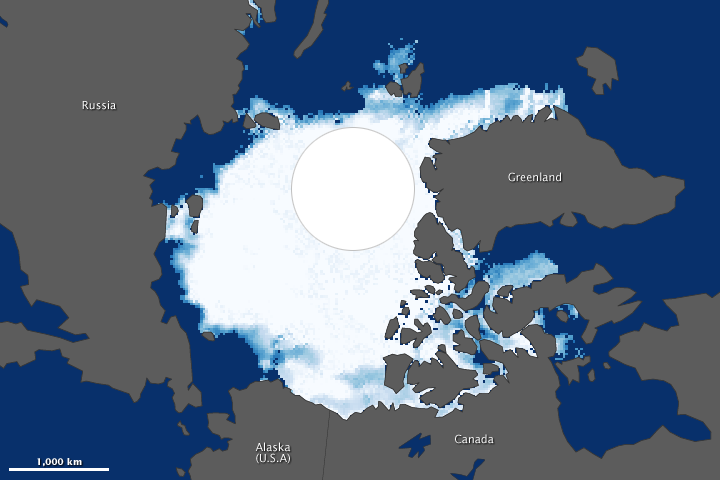
Arctic sea ice extent, September 1984. The 2012 minimum (not shown) was 45% less than this. Image: NASA — public domain.
Something Has Shifted
A few years ago, the old farmers in the villages outside Varanasi started saying something that took a while for meteorologists to confirm in data: the rains are not the same.
Not that they stopped. Not that the monsoon disappeared. But that the pattern — the slow, steady accumulation of rain over June and July that refilled tanks and rivers across the Indo-Gangetic plain — had changed shape. Now it arrives in bursts. Days of unrelenting intensity followed by long, anxious silences. Then another burst. Then heat again.
They noticed before the instruments did, because they had been watching for generations.
Did you know? The Arctic is warming 3 to 4 times faster than the global average — a phenomenon called Arctic amplification. Since 1979, the Arctic has lost an area of sea ice larger than the entire Indian subcontinent.
What Global Warming Actually Means
The phrase "global warming" is technically accurate but misleading. It sounds like everything gets uniformly warmer, like the world is being gently heated. What is actually happening is more violent than that.
The Earth's average surface temperature has risen approximately 1.2°C above its pre-industrial baseline. That number is deceptively small. A 1.2°C rise in the average temperature of a system as large and interconnected as the Earth's atmosphere does not produce gentle, uniform warmth. It injects enormous additional energy into the climate machine.
And energy, in a physical system, creates instability.
The atmosphere holds more water. For every 1°C of warming, the atmosphere can hold approximately 7% more moisture — a relationship described by the Clausius-Clapeyron equation. More moisture means that when storms form, they have more water to release. Not more storms necessarily — but more intense ones when they come.
The jet stream is weakening. This high-altitude river of air normally separates cold polar air from warm tropical air, steering weather systems predictably across continents. A warming Arctic — which is heating at three to four times the global average — reduces the temperature gradient that drives the jet stream. A weaker jet stream meanders more, gets stuck, and holds weather systems in place for longer. This is why heat waves last weeks, why floods persist, why dry spells extend far beyond their normal duration.
Ocean heat is rising. The oceans have absorbed approximately 90% of the excess heat generated by greenhouse gas emissions. Warmer oceans evaporate more water, intensifying the moisture cycle. The Arabian Sea and Bay of Bengal — the two water bodies that feed the Indian monsoon — are measurably warmer than they were fifty years ago.
The Erratic World
The consequences are no longer projections. They are events that have already happened.
In 2022, Pakistan received in one week what should have fallen in several months. A third of the country went underwater. 1,700 people died. Forty million were displaced. The Indus River, which has sustained civilisation in that region for 5,000 years, broke its banks in ways it never had in recorded history.
Did you know? The Clausius-Clapeyron equation — a 19th-century thermodynamics formula — predicts that for every 1°C of warming, the atmosphere holds 7% more water vapour. This is why storms are becoming more intense even when their frequency doesn't change.
In the summer of 2021, a heatwave settled over northwestern North America. Lytton, a small town in British Columbia, recorded 49.6°C — a temperature that would have been extraordinary in the Sahara, let alone Canada. The town burned to the ground two days later. More than 600 people died from the heat alone across British Columbia.
In 2019 and 2020, southeastern Australia burned for months. Fires burned through 18.6 million hectares — an area larger than the state of Uttar Pradesh. The smoke turned skies orange as far away as New Zealand and South America. An estimated 3 billion animals were killed or displaced.
In Germany and Belgium in July 2021, more rain fell in two days than typically falls in two months. Rivers rose 8 metres in hours. 220 people drowned in their homes and cars in one of the wealthiest, best-infrastructure nations on Earth.
These are not isolated anomalies. They are the pattern.
What Varanasi Is Already Feeling
Varanasi sits on the Ganga, which means Varanasi sits at the receiving end of an enormous watershed. Whatever happens in the Himalayas — in glaciers, in snowpack, in the intensity of monsoon rain — eventually arrives at the ghats.
The Ganga floods have become more extreme. In August 2019, the river rose to 71.26 metres at the Varanasi gauge — the highest level in 45 years. The lower ghats were submerged. The ghats on the south side of the city turned into rivers themselves. In 2021, the river rose to 68.02 metres, again inundating large sections of the old city. These were not events caused by local rainfall alone — they were the accumulation of intense cloud-burst rain across the entire upper catchment area, concentrated and sent downstream.
Heat waves now reach 47–48°C. In May 2022, Varanasi and the broader Eastern UP region experienced a heatwave that held temperatures above 45°C for more than a week. Hospitals recorded heat-stroke cases. The elderly and outdoor workers were most vulnerable. Twenty years ago, temperatures above 45°C in Varanasi were rare. They are no longer rare.
The winter fog has thickened and lengthened. This one surprises people who associate climate change only with heat. Warmer air holds more moisture, and in the winter months the Indo-Gangetic plain's famous fog — always dense — has become denser and longer. Fog that once lifted by 10 in the morning now sometimes persists until early afternoon. Lal Bahadur Shastri Airport in Varanasi has seen increasing numbers of diversions and cancellations. Train delays across the region have grown. The fog itself is partly a warming symptom — more evaporation, more water vapour in the cool night air, thicker condensation.
The monsoon pattern has fragmented. The older farmers are right. IMD data from the past three decades shows that while total seasonal rainfall in UP has not dramatically declined, the distribution has changed. There are more extreme rain events — days where 100mm or more falls in 24 hours — and more extended dry gaps between them. For agriculture, this is damaging in both directions. Flooding damages standing crops. Dry gaps during critical growth windows kill what the floods didn't reach. The reliable, slow monsoon that farmers calibrated their entire calendar around is becoming less reliable.
Why This Matters for Children Specifically
In 2023, scientists published a study calculating the generational exposure gap — how many more extreme weather events a child born today will experience compared to a child born in 1960, under different warming scenarios.
Under current trajectories, a child born in 2020 will experience on average seven times more heatwaves, twice as many droughts, and three times as many crop failures as someone born in 1960 — over the same lifespan. These are not distant future projections. They describe the childhood and adult life of children who are in classrooms right now.
This is not something to tell children to frighten them. Fear without agency produces paralysis. But understanding — real, scientific understanding of what is happening to the atmosphere and why — produces the opposite of paralysis. It produces the ability to adapt, to prepare, to build resilience, and eventually to change the systems that are driving the problem.
A child who understands the Clausius-Clapeyron equation understands why Pakistan flooded. A child who understands the jet stream understands why Varanasi baked in May 2022. A child who understands ocean heat dynamics understands why the monsoon is becoming more extreme.
Science does not cause anxiety about climate change. Ignorance of it does.
The Oldest Lesson the Ganga Offers
The river has always been a teacher here. It flooded before. It changed course before — there are geological records of the Ganga occupying completely different channels in this region thousands of years ago. The relationship between this city and its river has always been one of negotiation, not control.
But the speed of change now is different. The river is being asked to carry consequences it was not built to carry, accumulated over 200 years of industrial carbon emissions, most of which came from places far from here.
That is the other lesson worth teaching: the climate crisis is not a local failure. Its causes are distributed unevenly across the Earth. Its consequences are also distributed unevenly — falling hardest on countries that emitted least, on populations with the fewest resources to adapt.
Varanasi did not cause this. But Varanasi is experiencing it.
The children sitting in classrooms in this city deserve to understand both of these facts — clearly, scientifically, without euphemism. And then they deserve to be taught how to think, how to build, and how to care for the world they will inherit.
That is what a school is for.
Spark wonder
Tap to register your wonder
Share
Continue Reading
More articles connected to what you just read
What question did this raise for you? Add it below.
Reflections
Add your reflection
All reflections are reviewed before appearing. Keep it thoughtful.