Aryabhata and the Sky Above Varanasi
In 499 CE, a mathematician near Varanasi calculated Earth's circumference to within 1% — without leaving the ground. Indian science for children.
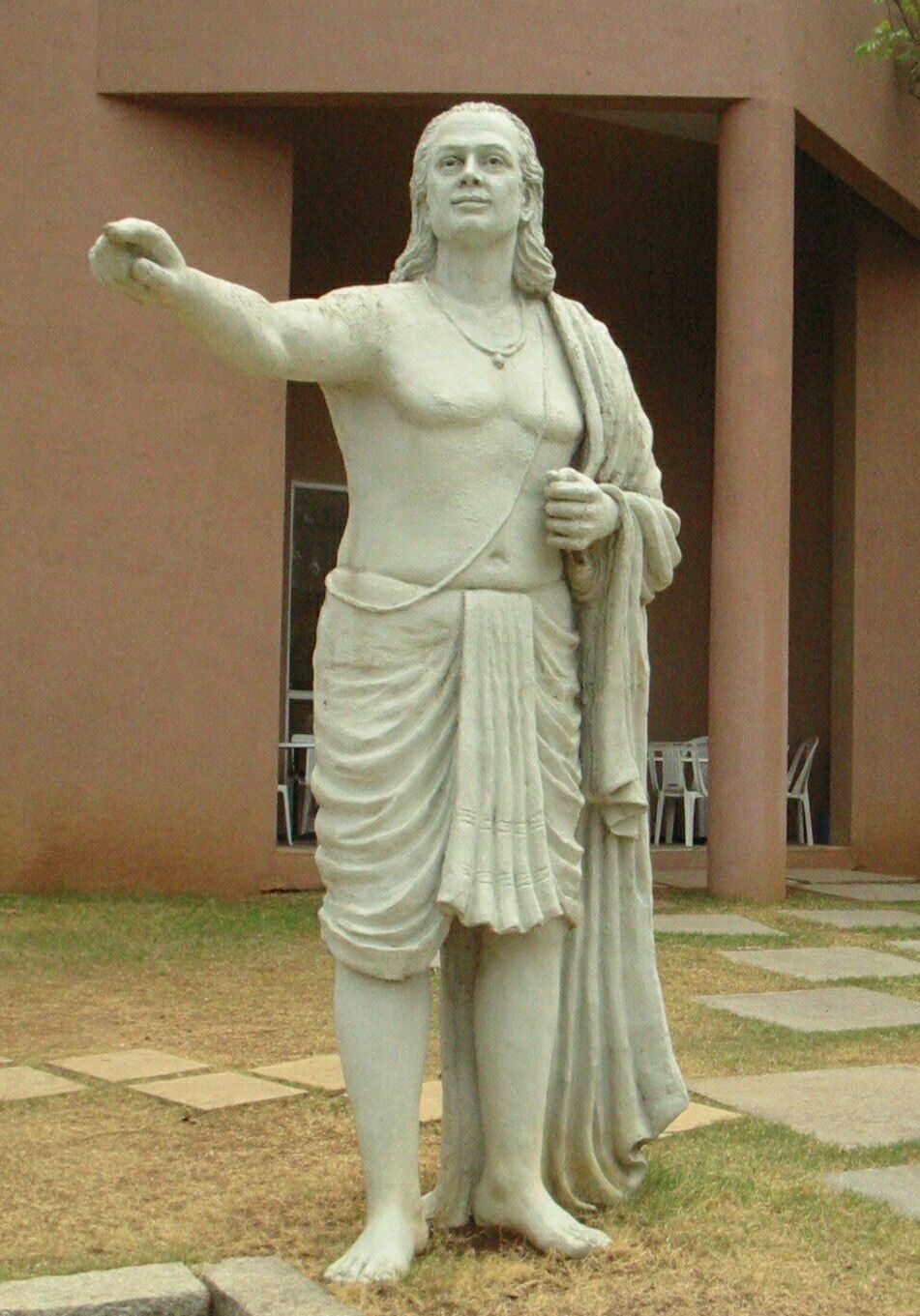
Aryabhata — mathematician, astronomer, and one of the great minds of ancient India. Image: Wikipedia Commons — CC BY-SA.
The Boy Who Measured the Sky
In 499 CE, a young mathematician wrote a book called the Aryabhatiya. He was 23 years old.
In it, he stated that the Earth rotates on its axis. That the apparent movement of the stars is caused by this rotation — not the stars moving around us. He calculated the circumference of the Earth to within 1% of the modern value. He gave a formula for trigonometric functions. He explained eclipses correctly.
He did all of this without a telescope, without a computer, without electricity.
His name was Aryabhata.
Aryabhata calculated that a year is 365 days, 6 hours, 12 minutes, and 30 seconds long. The modern value differs by just 3 minutes and 20 seconds.
How He Did It
Aryabhata used mathematics developed over centuries in the Vedic tradition. He used sine tables — a mathematical tool he helped invent — to calculate planetary positions. He used geometry to measure shadow angles during lunar eclipses.
He observed. He recorded. He reasoned from evidence to conclusion.
Did you know? The word "sine" in trigonometry comes from a mistranslation of Aryabhata's Sanskrit term jya — his sine tables were so precise that they were adopted by Arab mathematicians, who then passed them to medieval Europe.
This is the same method we call science today.
The place where this tradition was strongest was the Ganga plain — Pataliputra, Ujjain, Varanasi. The river cities were centres of learning because they were crossroads: merchants, scholars, and priests from across the subcontinent met and exchanged knowledge on the ghats.
What He Understood That Was Forgotten
Aryabhata knew the Earth moved. Centuries later, in medieval Europe, people were still being persecuted for suggesting the same thing.
Knowledge does not always flow forward. It can be lost. It must be re-discovered, re-argued, re-proved.
This is why we still teach it. Not because history is past — but because the questions Aryabhata asked are the same ones your students are beginning to ask now.
How big is the Earth? How far is the Moon? Why do eclipses happen?
He answered these questions using only his mind, a shadow, and time.
That is what wonder produces.
Spark wonder
Tap to register your wonder
Share
Continue Reading
More articles connected to what you just read
Learning
The Map in the Sky: How Varanasi Has Read the Stars for Three Thousand Years
What question did this raise for you? Add it below.
Reflections
Add your reflection
All reflections are reviewed before appearing. Keep it thoughtful.